10DLC trust score and your daily texting limits.
What the score is, the T-Mobile and AT&T limits at each tier, what raises or lowers it, and what to do when it comes back low.
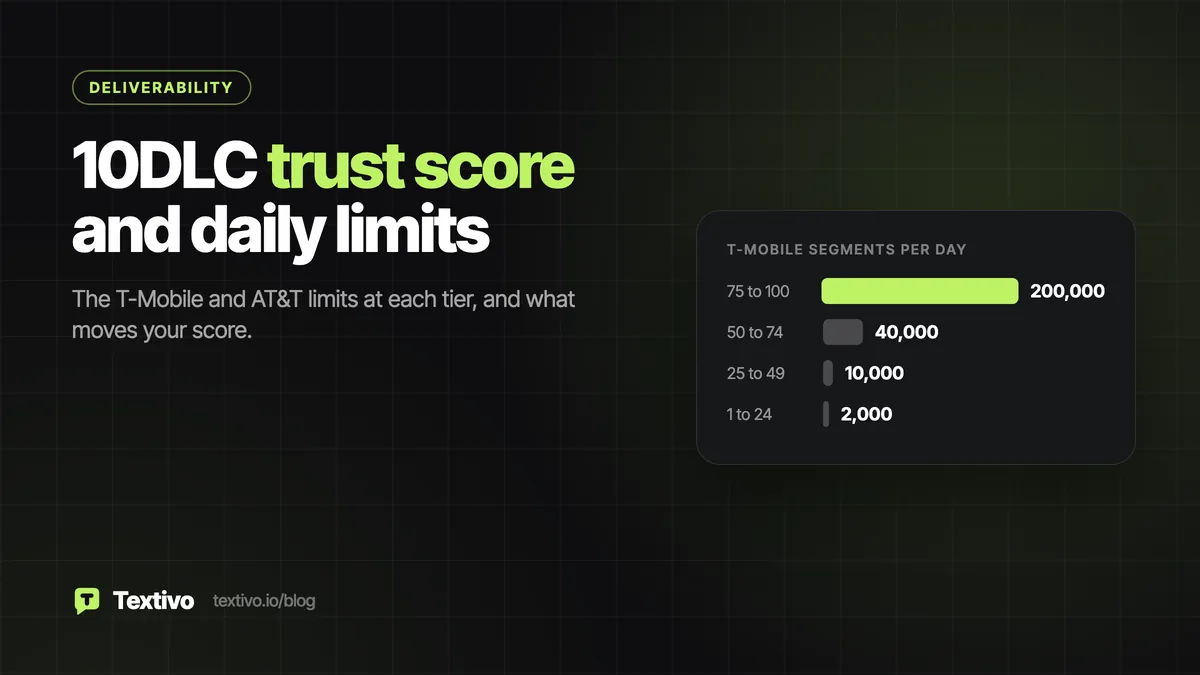
A 10DLC trust score is a number from 0 to 100 that your brand gets when it is vetted through The Campaign Registry. T-Mobile and AT&T use it to decide how much your registered campaigns may send. A higher score means more texts per day and per minute, which matters most when a large list or an AI SMS campaign has to go out on a deadline.
Trust score tiers and limits.
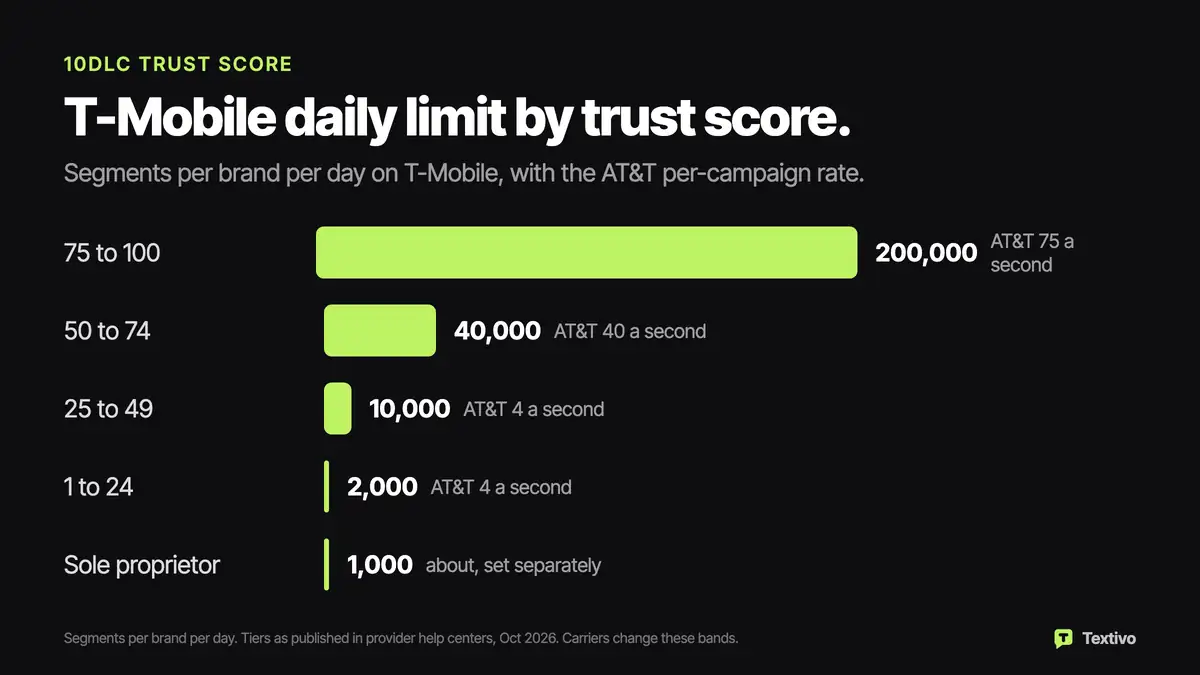
A score of 75 or more allows 200,000 segments a day per brand on T-Mobile, and a score under 25 drops that to 2,000.
| Trust score | T-Mobile, per brand per day | AT&T, per campaign |
|---|---|---|
| 75 to 100 | 200,000 segments | 75 a second (4,500 a minute) |
| 50 to 74 | 40,000 segments | 40 a second (2,400 a minute) |
| 25 to 49 | 10,000 segments | 4 a second (240 a minute) |
| 1 to 24 | 2,000 segments | 4 a second (240 a minute) |
| Sole proprietor | about 1,000 segments | Set separately, low |
Tiers as published in provider help centers (JustCall, 7 Oct 2026). Low-volume mixed campaigns are held to 1.25 a second on AT&T at any score. Carriers change these bands; your provider shows your current limits after vetting.
Verizon does not publish trust tiers. The lowest limit across the carriers decides how fast a send can really go. The 10DLC throughput calculator shows how many days a list of your size takes at your score.
What affects your trust score.
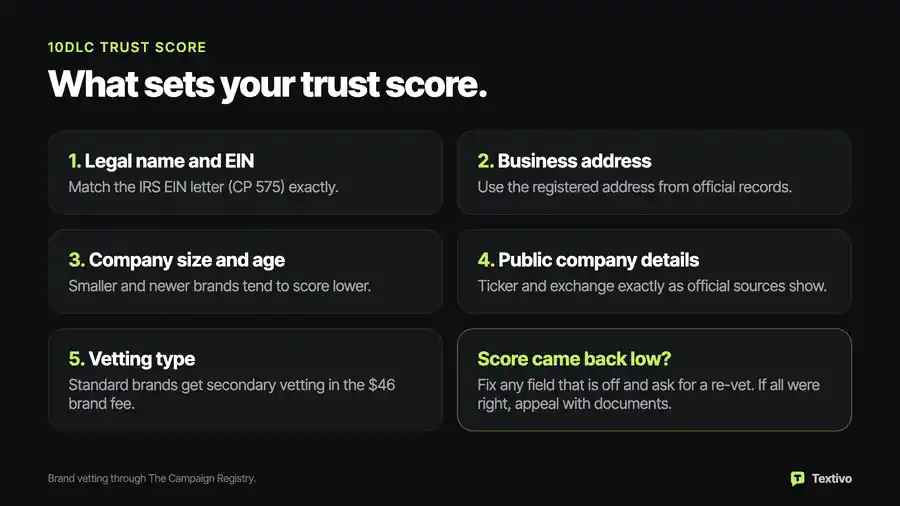
- Legal name and EIN. Enter the company name exactly as it appears on your IRS EIN letter (CP 575). A mismatch is a common reason for a low score.
- Business address. Use the registered address. A street, city or postal code that differs from official records can lower the score.
- Company size and age. Smaller and newer businesses tend to score lower, and no form field changes that.
- Public company details. A listed company should give its stock ticker and exchange exactly as official sources show them.
- Vetting type. A standard brand gets secondary vetting as part of the $46 brand fee. A low-volume standard brand skips vetting and is held to low limits.
How to improve a low trust score.
Start by checking every field against your IRS letter and your state filing. If something was wrong, correct it and ask your provider to vet the brand again. If the details were right, the next step is an appeal with documents, such as articles of incorporation and the EIN letter. An appeal does not promise a higher score. Changing the legal name or EIN means a new brand registration, not an appeal.
The campaign side matters too. Keep one use case per campaign, write sample messages that match what you will really send, and describe clearly how people opt in and how they opt out.
Sending inside your limit.
A high daily limit is not a reason to send everything at 9 a.m. Spread the send across the day by each person's time zone, inside texting quiet hours by state, and hold the follow-up until replies to the first text have come in. In Textivo you set a per-minute cap and the hours a send may run, and a number is retired when its health drops.
FAQ.
What is a 10DLC number?
A standard 10-digit US local phone number used for business texting, also called application-to-person (A2P) messaging. 10DLC stands for 10-digit long code.
What does 10DLC compliant mean?
Your brand and each campaign are registered through The Campaign Registry, and what you send matches the registered use case. That is a carrier requirement. The legal side is consent from the people you text, covered in TCPA text message rules.
What is A2P 10DLC approval?
After you register a campaign, it is reviewed before it can send. Approval means the campaign may send on 10DLC numbers at the limits your trust score allows. A rejected campaign can be fixed and sent again, and each new submission pays the $15 campaign vetting fee.
How do I get a 10DLC number?
Buy a local number from a texting provider and attach it to an approved campaign. In Textivo, registration happens in the app and local numbers are bought in bulk for your pool.
Conclusion.
Your 10DLC trust score sets the daily and per-minute ceiling for every campaign you send. Get the legal name, EIN and address exactly right before vetting, and appeal with documents if the score still comes back low. The 10DLC registration guide has the full checklist and fees.
Registered in the app, paced the way you set.
Brand and campaign filed from inside Textivo. 10DLC fees passed through at cost. A per-minute cap and send hours you control.