Text message character limit for SMS, MMS and iMessage.
Why one SMS holds 160 characters, why emoji drop it to 70, what happens to a longer text, and how MMS, iMessage and RCS differ.
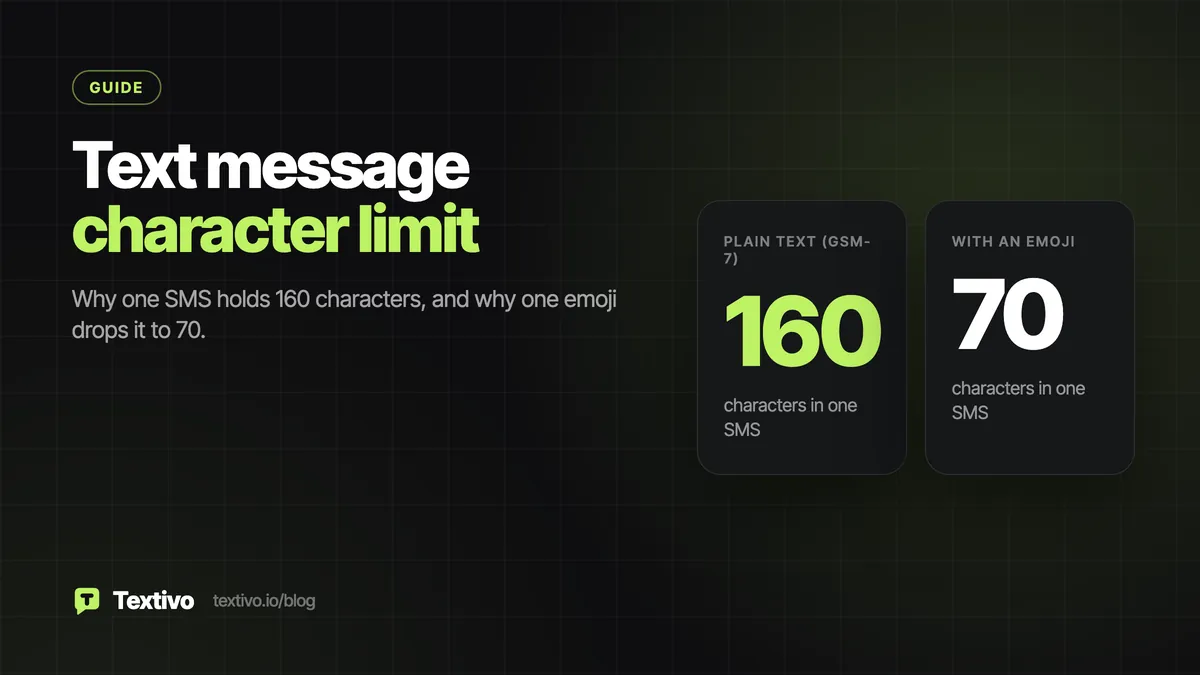
The text message character limit for one SMS is 160 characters. That holds when the text uses plain letters, numbers and common symbols. Add one emoji and the limit drops to 70. A longer text still sends, but it travels as several parts that your phone joins back together. This guide explains where the numbers come from and how they change on iPhone, Android and business numbers.
How long can a text message be?
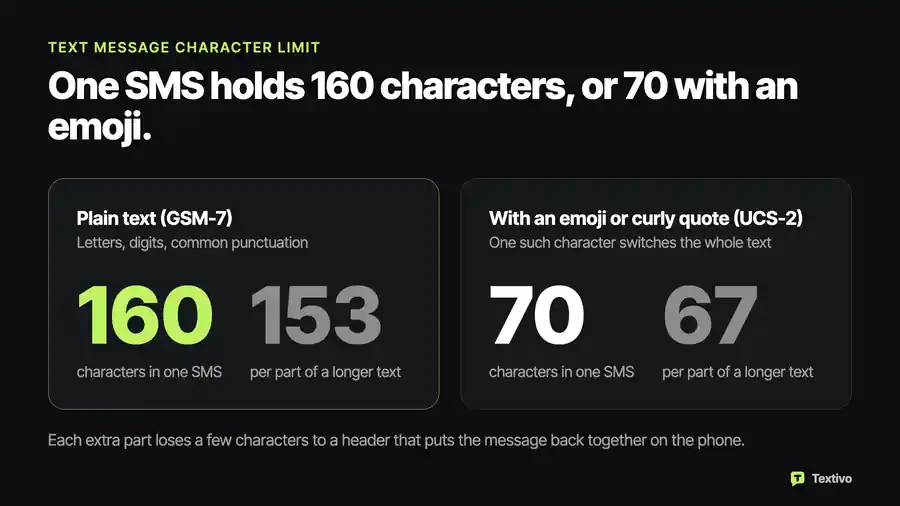
The answer depends on what kind of message it is. Here are the limits in one place.
| Message type | Characters |
|---|---|
| One SMS, plain characters | 160 |
| One SMS with an emoji or other special character | 70 |
| Each part of a longer plain SMS | 153 |
| Each part of a longer SMS with an emoji | 67 |
| MMS | Set by the carrier, no single standard |
| iMessage and RCS chat | Far higher, not tied to SMS limits |
Spaces, line breaks and punctuation all count. So does every letter of a name or link you paste in.
Why the text message character limit is 160.
SMS was built in the 1980s to ride on the part of the mobile network that phones already used to set up calls. That channel had room for 140 bytes of text per message.
Engineers then picked a 7-bit alphabet, called GSM-7, for the letters. Seven bits per character instead of eight let 160 characters fit in 140 bytes. The alphabet covers English letters, digits, common punctuation and some accented letters.
The story usually told is that Friedhelm Hillebrand, who chaired the group behind the standard, typed out short notes and questions in 1985 and found most fit in about 160 characters. Postcards and telex messages pointed to a similar length, so 160 stuck.
What changes the count.
Three things change the count without the reader noticing.
- Emoji and symbols outside GSM-7. One of them switches the whole text to a 16-bit format called UCS-2. Each character then takes two bytes, so 140 bytes hold only 70. Most emoji take four bytes, so each one uses 2 of those 70.
- Curly quotes. Phones and word processors often turn straight quotes and apostrophes into curly ones. Curly quotes are not in GSM-7, so one of them has the same effect as an emoji.
- Extended symbols. A few symbols are in GSM-7 but need an extra code, so each counts as two. They are { } [ ] ~ \ | ^ and the euro sign.
Accents matter for some languages. GSM-7 includes letters like é and ñ, but not á, í, ó or ú, so a Spanish text with any of those letters falls into the 70-character format. Texts in scripts like Chinese, Arabic or Hindi do too.
The fastest way to see where a draft stands is to paste it into the SMS segment calculator. It shows the encoding, the count and any character that broke the plain format.
What happens when a text goes past 160?
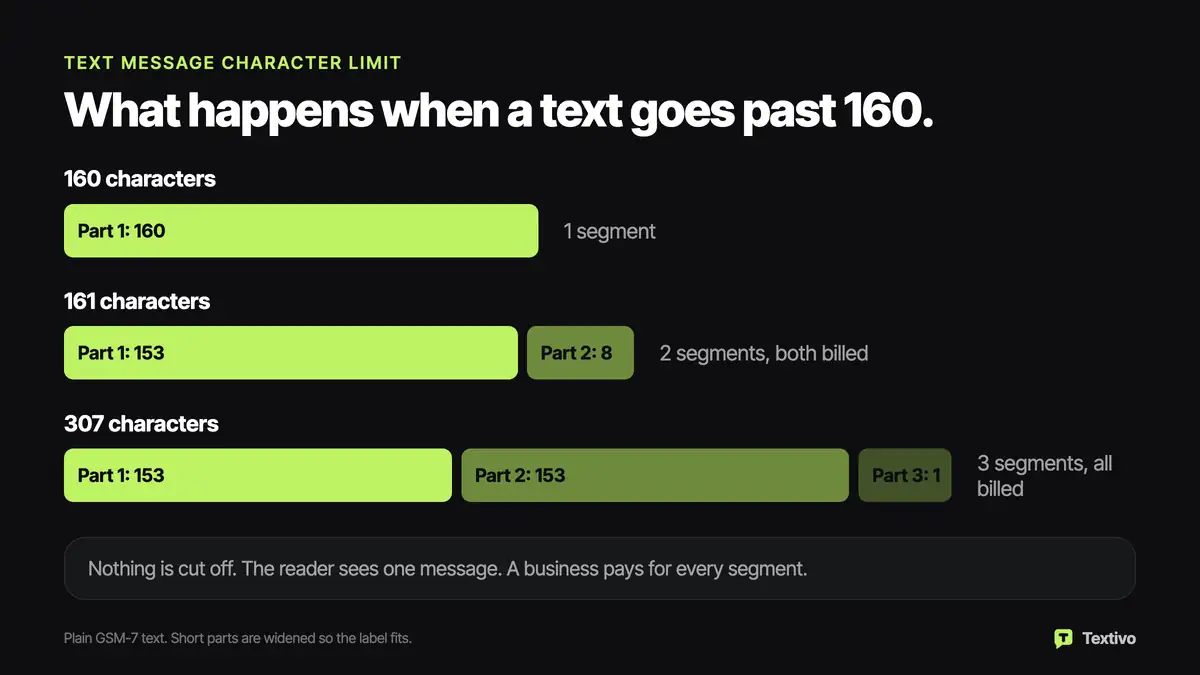
Nothing is cut off. The phone or platform splits the text into parts called segments. Each part carries a small header that tells the receiving phone how to put the pieces back in order. That header uses 6 of the 140 bytes, which is why each part holds 153 plain characters, or 67 in the emoji format.
A 161-character plain text becomes two segments. A 307-character text becomes three. On a modern phone the reader sees one message, not three.
There is still a ceiling. Some phones and carriers send a long text as MMS instead of a string of SMS parts. Business platforms also set a maximum number of segments per message, so check yours before you write a long one.
SMS vs MMS character limits.
MMS is the format for picture messages, and many phones also use it for group texts. It carries text along with an image, a short video or a file.
MMS has no single character limit that holds everywhere. Each carrier sets its own size limits, and the text shares that space with any media you attach. If a number matters to you, check with the carrier or the platform you send through. Some sending platforms cap the text in one MMS at 1,600 characters.
MMS suits a flyer or a map. For a plain message, a short SMS is the simpler choice, since it does not depend on the picture loading.
iMessage and RCS are not SMS.
On an iPhone, a blue bubble means iMessage. It runs over the internet between Apple devices and is not bound by the SMS limit. RCS is the newer chat standard on Android, and between recent iPhones and Android phones. It also sends over data and allows much longer messages.
Both fall back to SMS or MMS when the other phone or network cannot use them. Then the 160 and 70 limits apply again.
Business texts sent from a regular 10-digit number through a texting platform go out as SMS or MMS. That is why length counts more for a business sender than for a friend on iMessage.
Seeing the count on iPhone and Android.
On iPhone, Messages settings have a Character Count switch for SMS and MMS. Once it is on, a counter appears as a green-bubble text gets long. It does not apply to iMessage.
On Android, it depends on the messaging app. Some show a small counter near the send button as a text nears a segment break, and some show none. Menus and counters vary by phone and app version.
Why length costs more for business texts.
On a personal plan, a two-part text usually costs nothing extra. For a business, carriers add a fee to every business text segment, and platforms price by the segment too. A list of 2,000 people that gets a two-segment text uses 4,000 segments. Textivo also uses per-segment pricing. To see what a send will come to, run the numbers through the SMS cost calculator.
Length is only one rule. Before you send marketing texts from a texting platform, get the person's prior express written consent, as the TCPA text message rules require. Separately, carriers require 10DLC registration for business texts from a regular 10-digit number. Some states also limit the hours you may send, so check texting quiet hours by state. This is general information, not legal advice.
Tips to stay under 160 characters.
- Name your business first, once. Then skip the sign-off at the end.
- Cut filler. "We wanted to let you know that" adds nothing.
- Use digits. Write "3 p.m." instead of "three in the afternoon."
- Use a short link on your own domain. Count it at about 22 characters.
- Watch for curly quotes. Phone keyboards often curl quotes and apostrophes as you type. Check the draft before you send.
- Leave room for names. Test with a long first name, not a short one.
- Keep "Reply STOP to opt out" in. It is 21 characters well spent.
Here are three examples for made-up businesses. Each fits in one segment once a first name and a link are filled in.
- Hi [Name], Copperleaf Bakery here. Fresh rye is back this Saturday. Order ahead and skip the line: [link] Reply STOP to opt out.
- Hi [Name], Ridgeway Bike Shop here. Our spring tune-up special runs through May 31. Book a slot: [link] Reply STOP to opt out.
- Hi [Name], Larkspur Pet Clinic here. We now open at 7 a.m. on weekdays for drop-offs. Reply STOP to opt out.
For a one-way send to a whole list, such as a closure notice or a sale, a text blast sends each person their own copy from your business number.
FAQ.
Is the limit 140 or 160 characters?
Both numbers are right in a way. One SMS carries 140 bytes. With the 7-bit GSM-7 alphabet, those 140 bytes hold 160 characters. The 140 figure also stuck in people's minds because early Twitter capped posts at 140 characters to leave room for a username inside one 160-character text.
Can a text message be too long to send?
Yes. Sending platforms set a maximum number of segments for one text, and some phones turn a long text into MMS, which has its own carrier limits. If a message runs past a few segments, it is usually better as a short text with a link to a web page that holds the full details.
Do group texts have a different limit?
Often, yes. When you text several people at once from a phone, it usually goes out as an MMS group or as an iMessage or RCS chat, not as plain SMS. MMS limits are set by each carrier, and iMessage and RCS allow far more. A business send to a list goes to each person as their own text instead.
Will the reader see my text split into pieces?
Rarely on a modern phone. The header in each segment tells the phone how to rebuild the text, so it shows as one message. Very old phones, or a part that arrives late, can show pieces out of order. Keeping a text to one segment avoids the problem entirely.
Conclusion.
A single SMS holds 160 plain characters, a limit set by the 140 bytes the network had room for in the 1980s. One emoji, curly quote or letter outside GSM-7 drops it to 70. Longer texts split into parts of 153 or 67 characters and are joined on the phone. MMS limits depend on the carrier, while iMessage and RCS are not SMS at all. For business texts, every segment is billed, so length is money. Your next step is to paste your most-used text into a segment calculator and trim it to one segment.
See it on your own list.
A 30-minute demo: we upload a sample list, the AI texts it, and you watch the replies and the bookings come in.