SMS response rate dropped? Find the cause.
How to calculate SMS response rate, why a single benchmark misleads, and one check for each common cause: carrier filtering, number health, message length, list quality and the message itself.
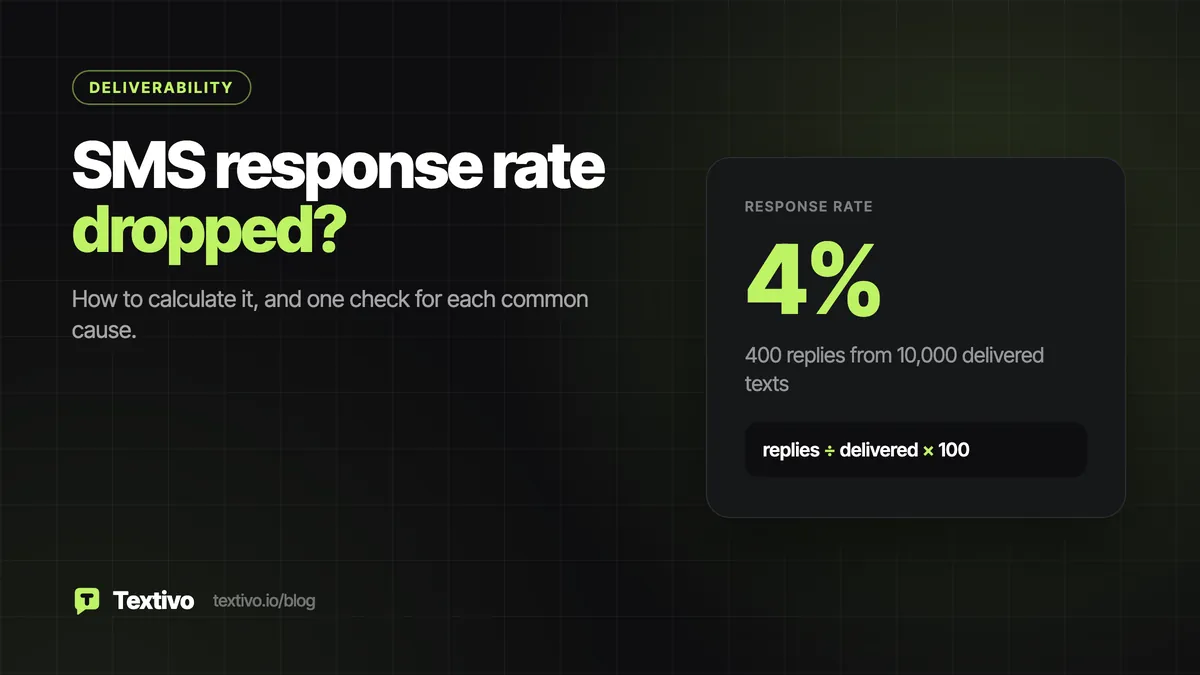
SMS response rate is the share of people who reply to a text campaign, whether a person or AI SMS answers them. When it falls, the cause is usually something you can check: texts being filtered, a weak number, a message that grew past one segment, a tired list or a tired message. Work through them in that order, because the first ones are the quickest to find and fix.
How to calculate SMS response rate.
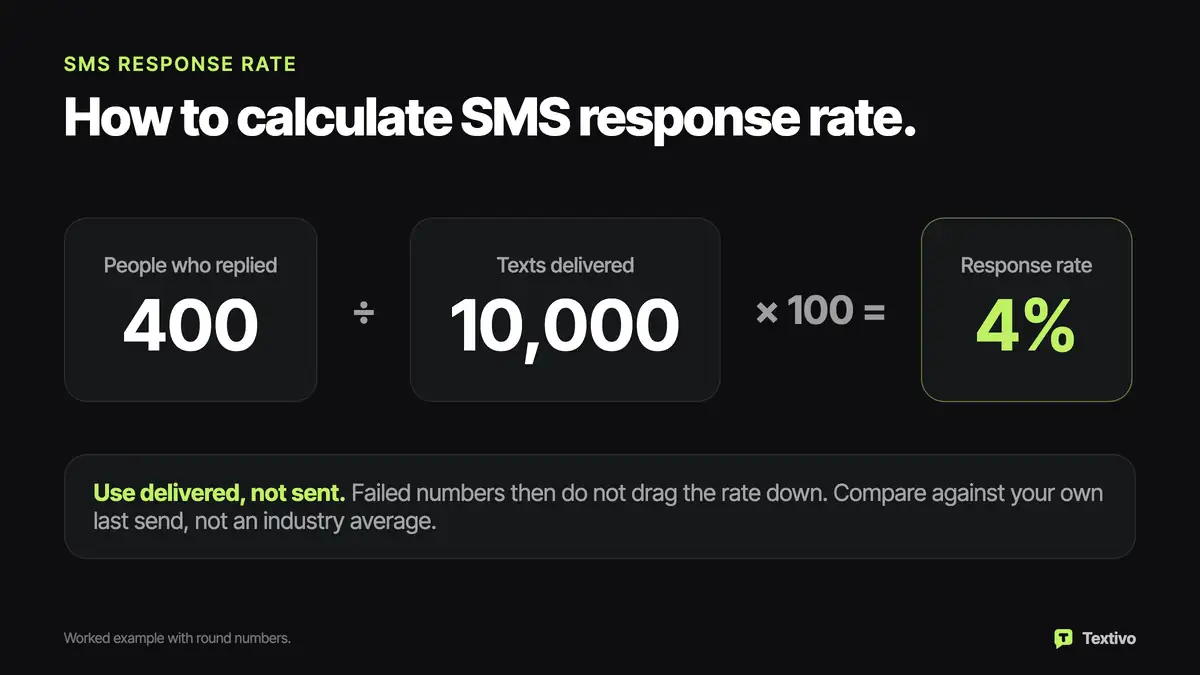
Divide the people who replied by the texts delivered, then multiply by 100. If 10,000 texts are delivered and 400 people reply, the response rate is 4 percent. Use delivered, not sent, so failed numbers do not drag the rate down. Count each person once, even if they reply three times.
What is a good SMS response rate?
No single number holds for every list. The rate depends on who is on the list, whether they asked to hear from you, and what you ask them to do. The useful benchmark is your own: the same kind of list, the same offer, last month. A drop against that is the signal to start the checks below.
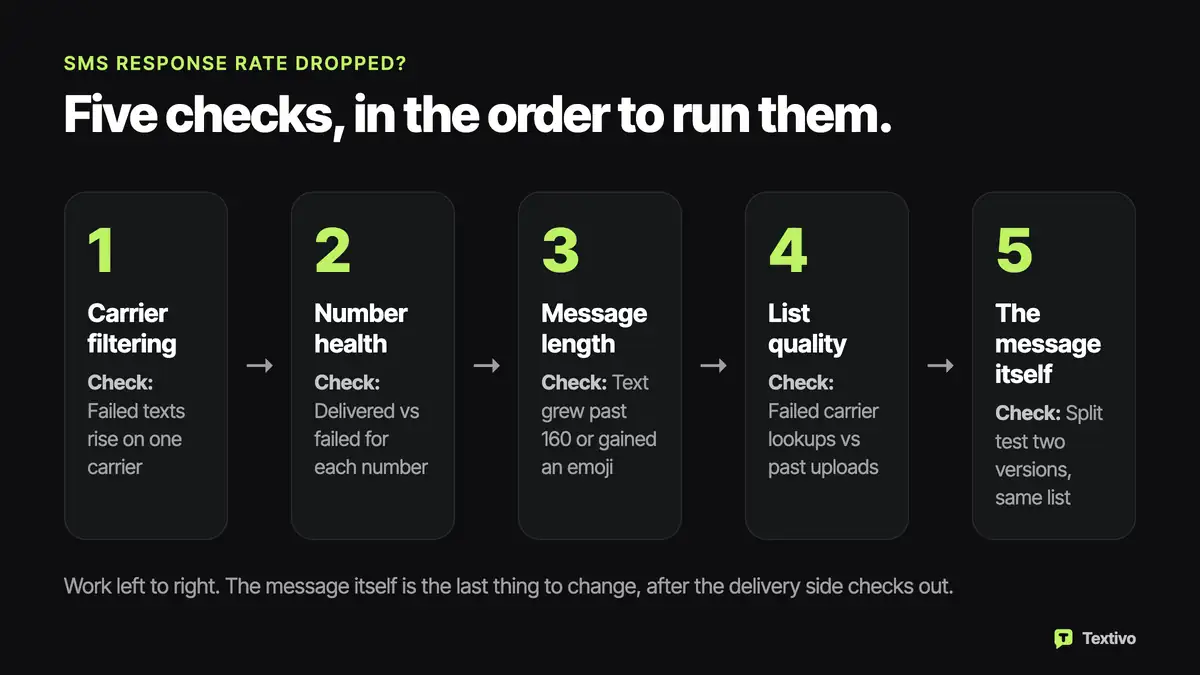
1. Carrier filtering.
Delivered does not always mean seen. Carriers filter texts that look like spam under the CTIA messaging principles, and the sign is a rise in failed texts on one carrier, or replies that fall while delivery looks fine. Check: send the campaign message to a few test phones on different carriers. If phones on one carrier never get it, that carrier is filtering it. Common triggers are public link shorteners, the same text sent thousands of times unchanged, and content that does not match the registered campaign.
2. Number health.
A number that people report as spam keeps sending but lands less often. Check: delivered and failed for each number in the pool. If one number fails far more often than the rest, take it out of the pool. Textivo shows delivered, failed and opted out for each number, and retires a number when its health drops.
3. Message length.
A text that grew past 160 characters now sends as two segments, so your cost per reply doubles even if replies stay the same. One emoji or curly apostrophe switches the text to UCS-2, where one segment holds only 70 characters. Check: paste the message into the SMS segment calculator and cut it back to one segment.
4. List quality.
Lists age. Numbers are reassigned, people switch phones and landlines creep in. Check: how many numbers failed the carrier lookup on your last upload, compared with earlier uploads from the same source. A jump points to the list source, not the campaign. Textivo runs a live carrier lookup on every number before a send, so landlines and dead numbers are left out.
5. The message itself.
Check this last. The same opener sent to the same people month after month gets ignored. Check: split the next send into two versions with the same list, numbers and send window, and keep the version that gets more replies. A short question that is easy to answer, such as a yes or no, is a good place to start.
Other ways to raise replies.
- Answer fast. A lead who waits hours for an answer may have moved on. An AI SMS agent replies right away and asks your qualifying questions.
- Use first names. First names merge in from your list, so the text reads like it was written for one person.
- Ask for one thing. One clear question gets more answers than a message that asks for three.
FAQ.
Is reply rate the same as response rate?
Yes. In texting both mean replies divided by delivered texts. Use one definition across campaigns so the numbers compare.
Is 30 minutes too long to reply to a text?
For a new sales lead, yes. Someone who texts a business expects a quick answer and may contact a competitor while waiting. If your team cannot answer within minutes, see speed to lead for how an instant first reply works.
Should STOP replies count as responses?
Track them on their own line. A STOP is a reply, but it tells you the opposite of interest, so mixing it in can hide a problem with the list or the message.
Do follow-up texts raise response rate?
A short follow-up can get replies the first text missed, but each extra text adds cost and opt-outs. Leave a few days between texts and stop after a small number of tries.
Conclusion.
A falling SMS response rate usually has a cause you can find in an afternoon. Check filtering, numbers, length and list quality before you rewrite the message, and compare against your own past campaigns rather than a published average. The bulk SMS platform page shows the delivery reports and number health tracking that make those checks quick.
Know which number is failing before replies fall.
Delivered, failed and opted out for each campaign and each number. A live carrier lookup on every number before a send. Numbers retired when their health drops.